Nea Big Read Into the Beautiful North
Introduction
Into the Beautiful North is a quest novel in the grand tradition, though there are no medieval knights, magic rings, or light sabers inside its pages. Author Luis Alberto Urrea sets the novel in the present day, in the highly charged globe of the U.S.-Mexico border region.
Nayeli, an energetic and idealistic girl of xix, is coming of historic period in a Mexican village, more than one,000 miles from the edge. She and her friends spend their days working at low-wage jobs and surfing the Net for videos of their favorite bands and movie stars, dreaming of a wider world they have little hope of knowing.
They live in Tres Camarones (Iii Shrimps), a hamlet where folks like things to stay the same. But alter is coming fast. Nayeli'due south Aunt Irma has just been elected the first female Municipal President of the village. Almost all of the men of the village, including Nayeli'southward male parent, have gone north to the U.Due south. to find piece of work, and drug-dealing thugs take recently begun to target the village, anxious to profit from drug-ownership American surfers who frequent the nearby beaches.
1 night, Nayeli and her friends attend a screening of John Sturges's classic film, The Magnificent Vii. In the flick, a Mexican farming village is terrorized past a brigand until the village elders decide to fight back, electing three farmers to travel to the U.S. to find seven brave gunfighters to aid defend the village. Inspired, Nayeli vows to go on a mission to the U.S. to bring back seven men—including her father—to defend Tres Camarones confronting the drug-dealing bandidos. She persuades her loyal band of friends to accompany her on the unsafe journey, and the quest begins.
In Urrea's border earth, characters come into contact with tensions that arise from many kinds of divergence. Urrea explores, with compassion and humor, the microcultures within the border earth, from the residents of the Tijuana garbage dump to the upscale neighborhoods of San Diego, and reveals that the altitude between them is not as great as one might initially imagine.
Lacking influence, money, or power, Nayeli and her friends employ ingenuity, youthfulness, and hope to overcome obstacles, suggesting that a new generation can bring new solutions to one-time problems. Urrea cleverly subverts cultural stereotypes and literary traditions, creating a fresh approach to the archetype hero's journey.
Major Characters in the Novel
Nayeli
Able-bodied, bright, stiff-willed, and charmingly naïve, Nayeli is admired by loyal friends who, similar her, are only out of high schoolhouse, only share a dour future in the poor Mexican hamlet of Tres Camarones. She identifies with her Aunt Irma, a charismatic feminist, former bowling champion, and newly-elected Municipal President of Tres Camarones.
Yolo
Yolo, curt for Yoloxochitl, a proper name bestowed by her liberal Mexican parents to honor her Aztec heritage, was a straight-A student in high school "simmering with revolutionary ideas." Yolo works a dead-finish chore at the local bowling aisle, but reads everything she can.
Vampi
Veronica, known as Vampi, is the only goth daughter in the state of Sinaloa. Her expect is distinctive: black hair dyed fifty-fifty blacker, pale makeup, black lips and nails, and a long blackness skirt. Despite her appearance, Vampi's experience with goth civilisation is limited, derived from YouTube where she worships bands such as The 69 Eyes and Type O Negative.
Tacho
Tacho is the gay proprietor and cook of the village eating place, La Mano Caída (The Fallen Hand), a frequent hangout for Nayeli and her girlfriends. Tacho and Nayeli are kindred spirits, both dreaming of a cosmopolitan life in a large city. They sometimes climb upwards on the roof of the eating place to expect at the heaven, "making believe that clouds were the Manhattan skyline."
Matt
A young missionary once stationed in Tres Camarones, Matt is the first "real live blond boy" Nayeli and her friends have ever seen. After his return to San Diego, Matt lives frantically, until he receives a telephone call from Nayeli and the truthful extent of his generosity is revealed.
Atómico
Raised in the dumps of Tijuana and armed with a bamboo rod, Atómico brings his unique sense of justice to the journey. His scrappy and maniacal exterior hides a mixture of pride, loyalty, and humble nobility.
"They kept veering north, as if there would be some magical gap in the fences. As if there would be some style into the United states that nobody had ever tried, or that the Border Patrol had overlooked."
— Luis Alberto Urrea, from Into the Beautiful N
Luis Alberto Urrea (b. 1955)
Growing upwardly in Tijuana and San Diego with an American female parent and Mexican male parent, Luis Alberto Urrea was familiar with the complex realities of the U.S.-Mexico border from an early age.
The dualism in his personal history is reflected in a prolific and historic literary career. Urrea writes stories that portray reality on both sides of the border, creating humanizing portraits of immigrants as well every bit their adversaries. Equally the writer of many books, including poesy, fiction, nonfiction, and memoir, Urrea is a major figure in Latino literature and a fellow member of the Latino Literature Hall of Fame. His work transcends media stereotypes and gimmicky immigration disputes, revealing the border as a place of connectedness too every bit divide. "The Mexican border is a metaphor," he noted in a 2011 interview with Coloradan magazine. "Borders everywhere are a symbol of what divides the states. That's what interests me."
Urrea was born in a poor neighborhood in Tijuana. He inherited a rich legacy of family and cultural lore and a love of storytelling from his extended family, explored extensively in his literary work.
When Urrea was five, his parents moved across the edge to San Diego. From an early on age, he moved easily between the ii cultures. In a 2011 interview with the San Diego Reader Urrea said, "To me, Tijuana and San Diego were just inseparable; they were 2 sides of the aforementioned thing."
Urrea attended high school in San Diego, where he and a accomplice of artistic friends pursued burgeoning interests in verse, drama, and rock music.
In the late 1970s, shortly afterwards graduating from the University of California, San Diego, Urrea rediscovered Tijuana. A friend introduced him to "Pastor von" of Clairemont Emmanuel Baptist Church building in San Diego, a dynamic individual known for leading relief work projects in Tijuana's massive garbage dump. One of Urrea's first jobs as a relief worker was to wash the feet of the garbage pickers.
Although he grew upwardly a few miles from the site, Urrea was astonished to discover the dump, a literal mountain of garbage, that provides a meager source of income to a
large community of garbage pickers and orphaned children. The experience was profound for Urrea, who continued to volunteer at the site for years, and has since get
a voice for the inhabitants of the dump.
In the early 1980s, Urrea set up off in a new direction. With the assistance of a former professor, he secured a position at Harvard where he taught expository writing from
1982 to 1990. He too held teaching positions at Massachusetts Bay Community College and the University of Colorado.
In 1997, Urrea received an MFA from University of Colorado in Boulder, and today he is a professor of creative writing at the University of Illinois-Chicago. He lives with his family in Naperville, Illinois.
Updated July 2016
An Interview with Luis Alberto Urrea
Josephine Reed of the National Endowment for the Arts interviewed Luis Alberto Urrea on Jan 11, 2011, and Jan 12, 2013. Excerpts from those conversations follow.
Josephine Reed: Where did y'all get the idea for Into the Cute North?
Luis Alberto Urrea: I have family in Sinaloa where my uncle had a tropical movie theatre. Information technology had a corrugated tin can roof. Information technology had bats. When things would get really loud in the movie, the bats would dive-bomb the watchers. I started imagining what would happen to Sinaloa if at that place were no men of a certain age left. I realized that probably my aunt, who was Mexico's female person bowling champion and a terrifying character, would have taken over the boondocks. And then what would happen if narcos came to this town?
Part of what I was trying to practise, believe information technology or not, was write a dear poem about America. This nation is unbelievably blessed and gorgeous and magnificent—and we forget. There'due south a scene early on [in the book] when, in San Diego, they see giant lawns for the first fourth dimension. They have never seen green grass as far as yous can encounter, and it's cute, lush, watered, and they think, "Wow, this is Valhalla." That happened to me in my fifth-grade transition from the edge to a working-course suburb. What a daze. I never forgot information technology.
JR: Can yous tell u.s. about some of the characters in the novel and the mission they are on?
LU: Atómico is Toshiro Mifune in The Seven Samurai: this unwanted, uncouth, unwashed warrior who's wandering effectually looking for a mission. Yet on a deeper level, he's an oddly moral character, and blessedly eccentric. Nayeli was inspired by a immature woman at the Tijuana dump whom I've known since [her] birth. She touches me and so much because she tin't help but smile. People accredit all kinds of motives to her considering of her grin...I wrote the book equally a little
homage to her.
[I wanted to write a story in which] every person is on a journey, even the settled people, even the people in the U.S. Everybody is in transition, which is how I feel the earth is right now. So the border patrol amanuensis is about to retire, and he tin't find his identify. The young missionary boy has lost his faith, and his mom is gone, and he doesn't know what to do with himself. It's not but immigrants who are moving around. We're moving around, besides.
JR: The tone and temperament of the book is quite unusual—yous take a serious subject and oft look at it with humor.
LU: At the time that I wrote Into the Beautiful Northward, I had washed so much hard work on difficult books. Honestly, my writing rule was, "I want to express mirth every day." Laughter is a virus that infects everyone with humanity. I thought if I made the story really entertaining, if I made it an gamble, then information technology would make the general American reader not only want to read it, but make them maybe root for people they either don't think almost or really expect at with some disdain.
JR: Borders figure prominently in your work. In terms of culture, you realize that borders are more than than porous.
LU: The edge is, in a lot of ways, nonexistent. In these little villages, these girls are on the Cyberspace all day long. They're dancing to goth music from Norway on YouTube. They don't take any way to get hold of the world, but they encounter information technology. In the Tijuana garbage dump…there'south a little shack with tortillas and tamales and stuff, and he's got one or ii laptops, and the kids who pick garbage can get on this guy'southward Internet. On the other hand, there are borders everywhere. The border is a metaphor for what separates us from each other. Every audition I speak to is torn autonomously by fences. They just can't encounter them. My chore is to throw dear notes over the fence and meet who finds them.
"…I e'er hopelessly, passionately, root for the underdog."
—Luis Alberto Urrea from a One Book, One San Diego interview
Into the Beautiful Northward Builds Community, Engages Youth, and Inspires Literacy in English language Learners in Boston, Massachusetts
"Through the Large Read, nosotros were able to attain over 680 unique members of our customs, including children, youth and adults. The book was used equally a tool to bring together segments of our community that do non always interact. Our Mission Hill/Roxbury neighborhood includes professionals who work at Longwood Medical Expanse and local colleges, college students from nearby schools and low-income families. Although they alive in close proximity, these groups collaborate infrequently. Acknowledging the necessity of bridging these divides, we strategically designed Big Read events to bring these groups together. Community members of all ages, races, ethnicities, professions, and neighborhoods attended and participated in meaningful discussions around the themes in Into the Cute North. Many of our customs members thanked us for opening upwardly a dialogue on immigration in our community.
"Feedback from youth participants indicated that reading the book and participating in book discussions had a personal impact on them and their understanding of immigration reform and the role that youth can play in advocating for immigrant rights. At Sociedad Latina, a key slice of our mission is to work with youth to build their leadership and civic engagement skills, with the goal of preparing them to meliorate the world they inherit. Our Big Read activities provided a multi-disciplinary approach for our organisation to piece of work towards this goal. It provided participants with a new frame of reference to empathise immigration, to recollect about how oppression, racism and poverty continue to bear upon their lives today, and to explore how we tin can come together as a community to address these issues.
"The Large Read was likewise an effective way to get our community excited nearly reading. According to the nearly recent Massachusetts Country Assessment of Developed Literacy, most 50% of English language Linguistic communication Learners (ELL) in our state have "below basic" literacy skills, and the majority of Latino and Black residents in Massachusetts have significantly lower levels of literacy than their White counterparts. Many of the youth in our customs are considered academically "underperforming" because they are behind grade level in their literacy skills. The interdisciplinary nature of our activities and events attracted a diverse audience who might not otherwise be engaged in our programs. The pick to read the volume in Spanish made information technology more attainable for our Spanish speaking and ELL customs members to have part in the Large Read plan."
– from a report by Sociedad Latina, an NEA Large Read grant recipient in FY 2014-15.
Into the Cute North Author Speaks to Residents of a Juvenile Detention Facility in Wichita, Kansas
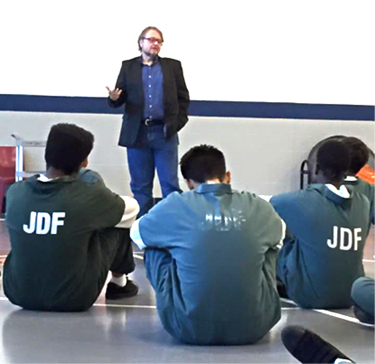
Into The Cute North author Luis Alberto Urrea speaks to residents at the Sedgwick Canton Juvenile Detention Facility every bit function of the Wichita Public Library Foundation's Big Read activities. Photograph courtesy of Wichita Public Library Foundation
– from a final report by the Wichita Public library Foundation, an NEA Big Read grant recipient in FY 2015-2016.
Dancers Perform at a Mariachi Fiesta Consequence Jubilant Into the Cute North in Atlanta, Georgia
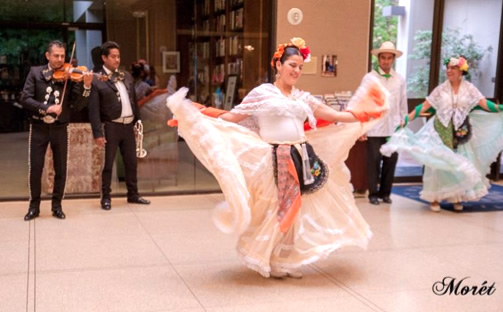
Photograph by Bonnie Moret, courtesy of the Atlanta History Centre
- from a report past the Atlanta History Center, an NEA Large Read grant recipient in FY 2014-2015.
Source: https://www.arts.gov/initiatives/nea-big-read/beautiful-north
0 Response to "Nea Big Read Into the Beautiful North"
Post a Comment